The clinic cannot code without these. Both tools touch no patient data and can be switched on by an administrator alone.
ITEM 1Being builtNo patient data
Maps a clinic’s own codes to the standards
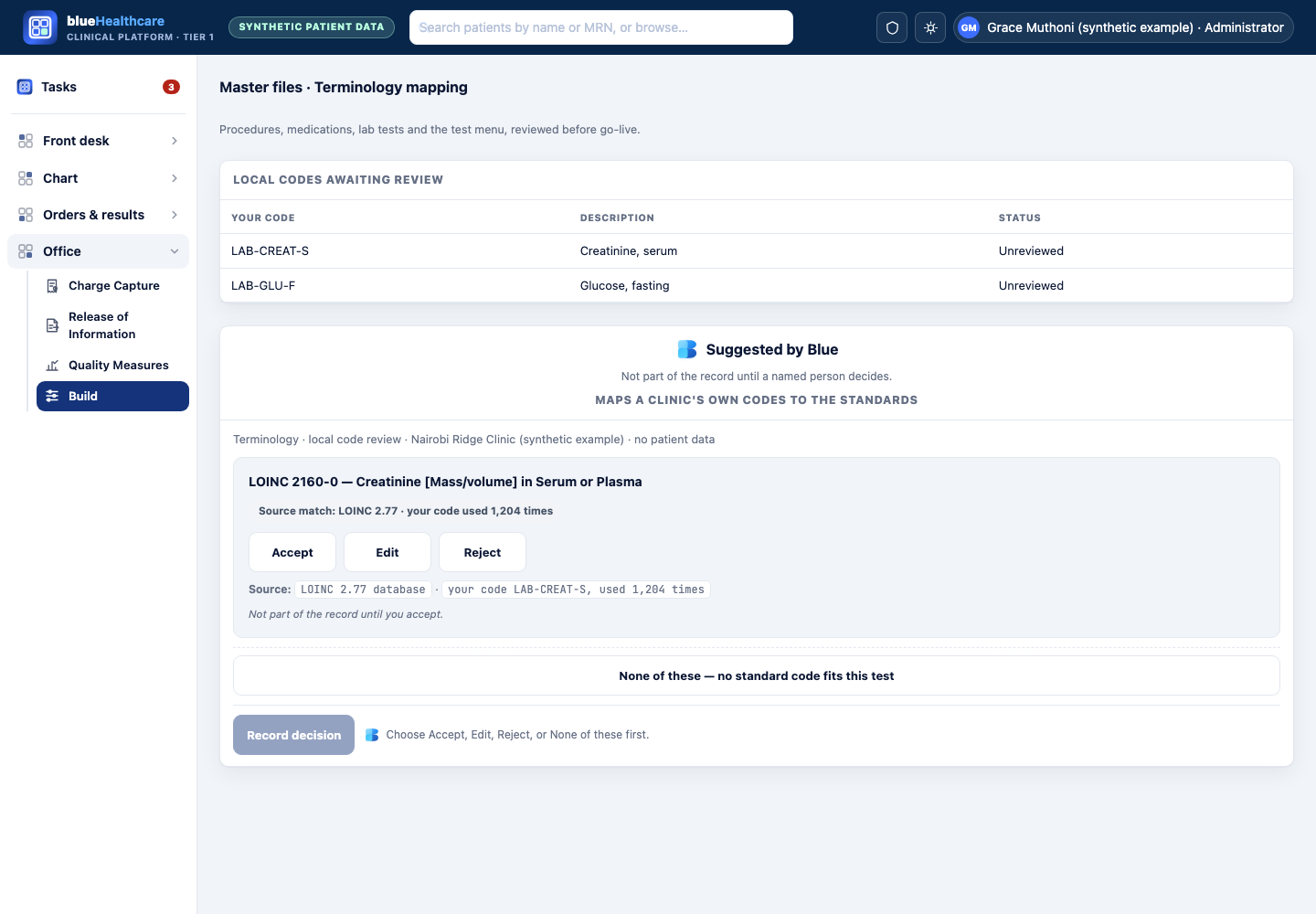
Turns a clinic’s home-grown procedure, medication, lab and test-menu codes into real SNOMED, ICD, or LOINC codes before go-live, so quality measures and interfaces have something real to point at.
Synthetic example walkthrough
Who
Grace Muthoni (synthetic example), the practice manager migrating Nairobi Ridge Clinic (synthetic example) onto blueHealthcare.
Situation
The clinic’s lab has used its own code “LAB-CREAT-S” for serum creatinine for eleven years. Nothing in the new system knows what that means yet, and until it does, critical-value checks on that test cannot run.
Blue shows
A ranked candidate: LOINC 2160-0, built from the local code’s description and how often it is used — never from any patient’s result.
They do
Grace checks the candidate against the lab’s own test menu and accepts it, or picks “none of these” and routes it to the lab director.
Design mockup · not built Shown inside blueHealthcare's real shell (top bar, left rail, product tokens) with synthetic data, composed from the platform's own components — not a live feature, and not a real screenshot of a shipped screen.
What it never does
Never marks a code live on its own — a person accepts each mapping.
Never guesses when the local description is ambiguous; it returns “none of these” rather than a low-confidence pick.
Never edits a mapping once approved — a change is a new, separately reviewed mapping record.
ITEM 2Being builtNo patient data
Finds the right code from a phrase
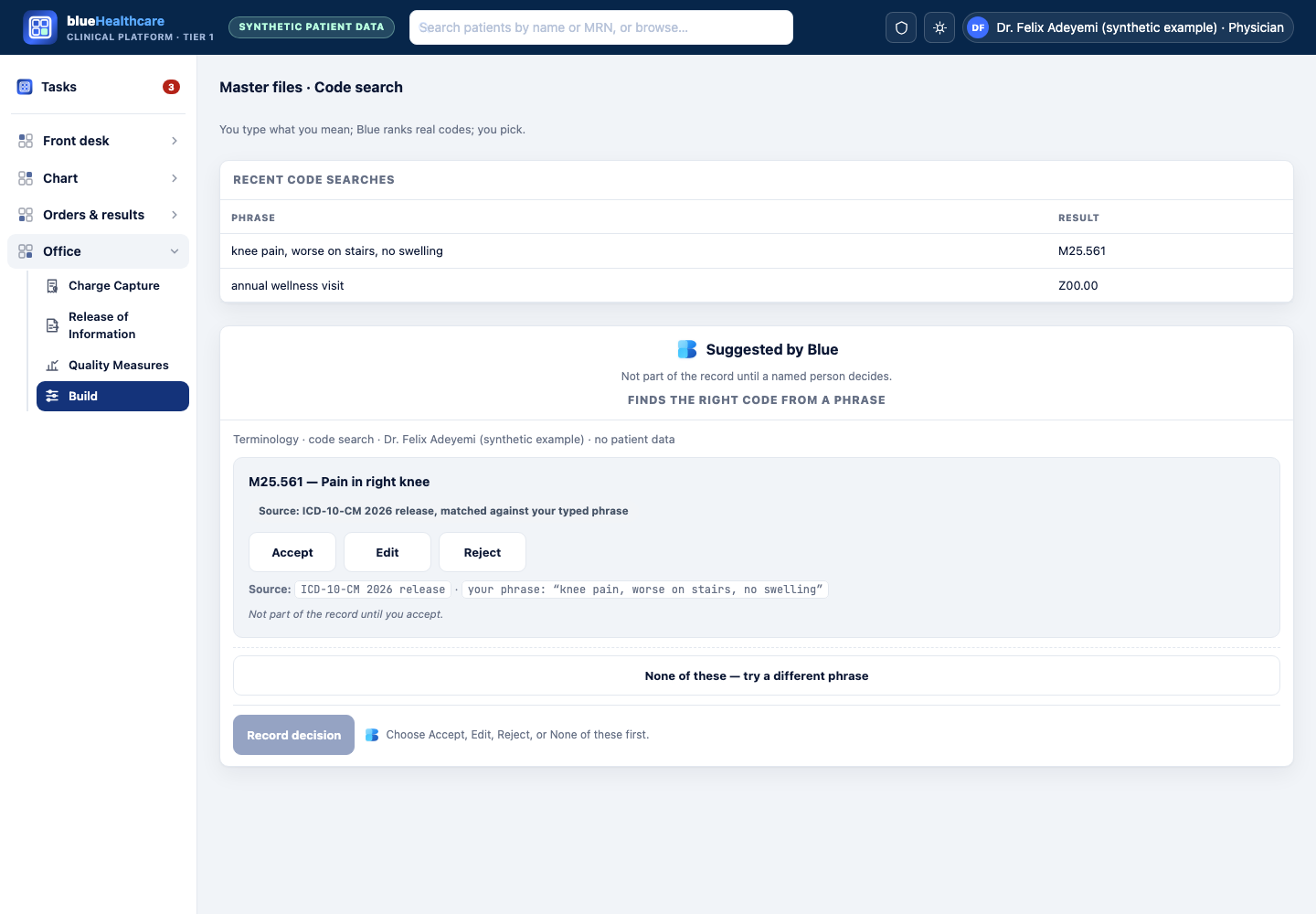
A clinician types what they mean in plain language; Blue ranks real codes from a real terminology; the clinician picks.
Synthetic example walkthrough
Who
Dr. Felix Adeyemi (synthetic example), a family physician at a two-doctor clinic with no coder on staff.
Situation
He is closing out a visit and needs an ICD-10 code but does not have the manual memorized.
Blue shows
He types “knee pain, worse on stairs, no swelling” into the code-search box. Blue returns a ranked list of matching ICD-10 codes with their official descriptions.
They do
Dr. Adeyemi reads the top three, picks the one that matches, or refines the phrase and searches again.
Design mockup · not built Shown inside blueHealthcare's real shell (top bar, left rail, product tokens) with synthetic data, composed from the platform's own components — not a live feature, and not a real screenshot of a shipped screen.
What it never does
Never assigns a code without the clinician’s own click.
Never ranks by what pays the most — ranking is by terminology match only.
Never records the search as anything but the clinician’s own act.