The missing layer between a decision and the record that defends it
Health plans make tens of millions of coverage decisions a year, and the ground under them is moving from several directions at once. The missing artifact usually isn't a smarter answer. It's a defensible file of the process that produced the answer: what was checked, what wasn't, who decided, and why.
Two developments are converging on the same requirement — a specific, checkable reason behind every coverage decision:
- CMS-0057-F calls for a specific, defensible reason behind every prior-authorization denial, with further API requirements arriving in 2027.
- NCQA utilization-management accreditation standards expect documented, consistent, qualified review.
The scale behind this: Medicare Advantage insurers alone made an estimated 53 million prior-authorization determinations in 2024, and of the ones appealed in 2023, an estimated 81.7% were partially or fully overturned. All figures in this paragraph are third-party estimates, not this site's own measurements.
No health plan today can hand an auditor, a regulator, or a court a decision file that proves who decided, on what evidence, under which rules — one that still verifies years later, independent of the vendor who produced it. Every incumbent system is built to do the workflow, not to prove afterward that it happened correctly. blueHealthcare builds that missing file, and does it beside the systems already in place: blueChart and blueClaims plug into the health plan's existing utilization-management case export — the same one already run through the plan's UM platform — not into the EHR, and not by replacing anything. Zero systems a customer must replace to adopt blueHealthcare.
The eight assurance products below — blueChart, blueClaims, and six research, laboratory and trial modules — are overlays: each sits above whatever EHR, UM platform, payer stack, or LIMS a clinic or plan already has, and produces a signed, offline-verifiable receipt of what a review actually checked. These products never replace the EHR, the UM platform, or the payer system.
Beneath the overlay products runs the blueHealthcare platform itself — registration, scheduling, notes, orders, results, medications, imaging, and more (see the 13-module platform). For a clinic that has no EHR today — the case blueOpenHealthcare is built for — blueHealthcare's platform is the record system. It is not an overlay in that setting because there is nothing underneath it to sit above.
Neither mode changes the one constant: a named human remains the only decision authority for every product in the suite. The packet never asserts a decision was correct — it proves what evidence, policy, software version, and named human took part, and whether anything has changed since.
The suite's shared mechanism is a typed coverage ledger: every requirement or evidence gap is marked searched and absent, never searched, or undetectable with these records — never one undifferentiated "not found." A denial, a refused license, or a missed error class can be checked against what the review actually had the ability to see.

blueChart and blueClaims read the case export your UM platform already produces — the plan keeps its UM system, its EHR, and its workflow exactly as they are today. blueHealthcare's job is narrower and different: bind the evidence, the policy version, and a named human's own signed decision into one file that still checks out years later, to anyone, without needing to trust MOBLUEHQ.
Three screens from the running platform and a flagship overlay product — a critical lab value surfacing with a closed-loop record, an order composer, and blueChart's typed evidence packet. See the full six-screen patient workflow.
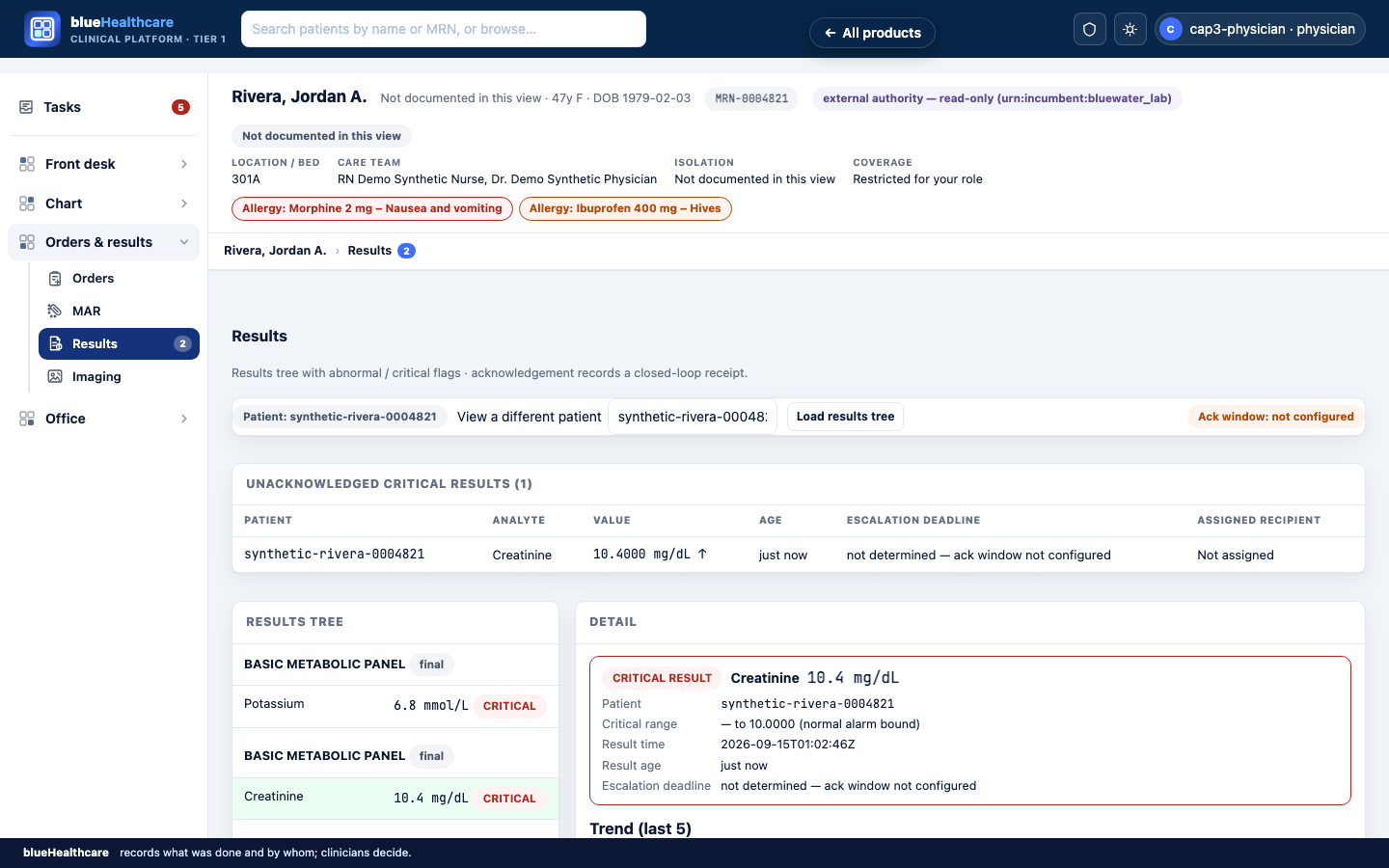
A critical result surfaces with a closed-loop acknowledgement record — the platform beneath the overlay.
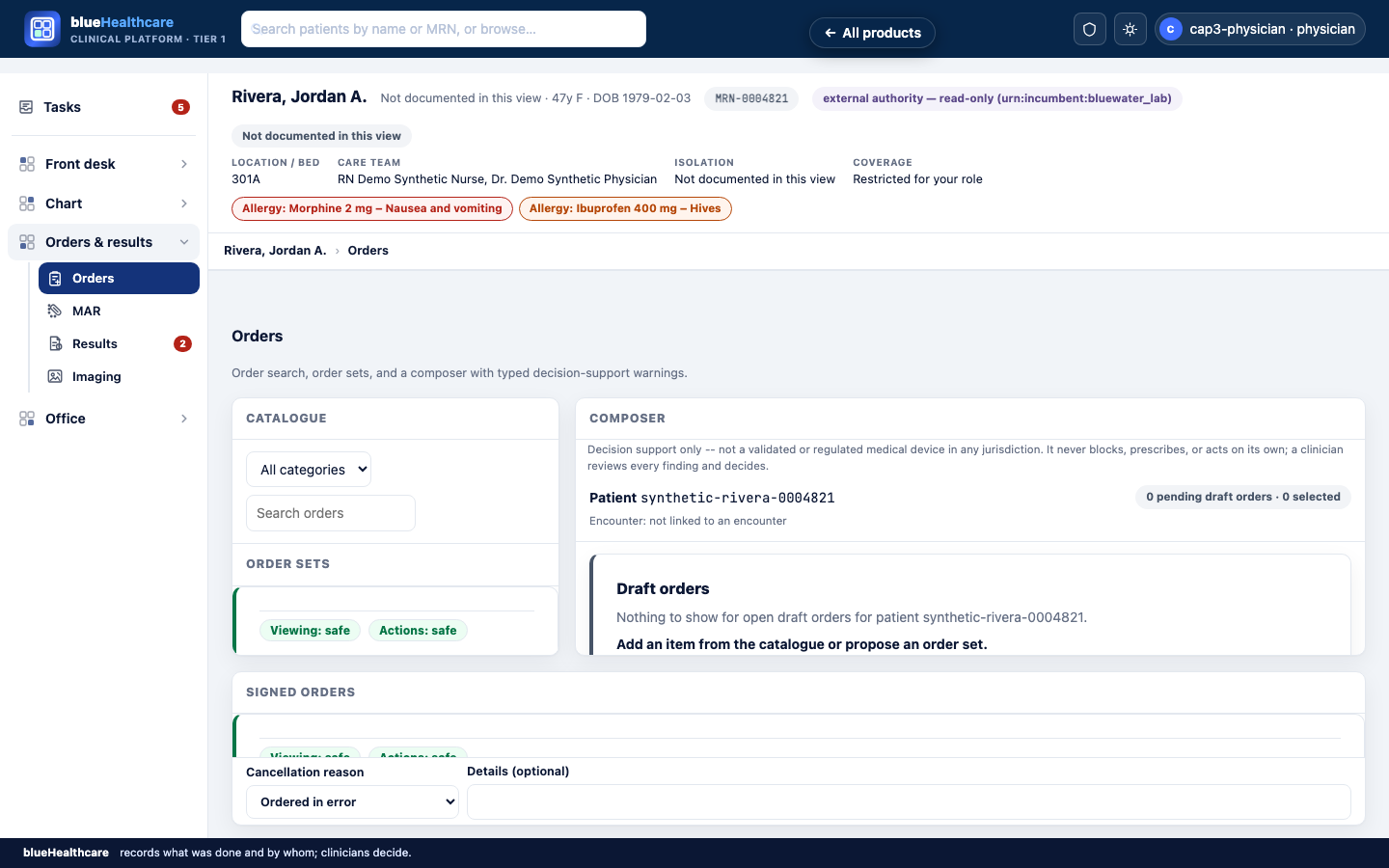
Order search, order sets, and a composer that tracks pending vs. signed orders.
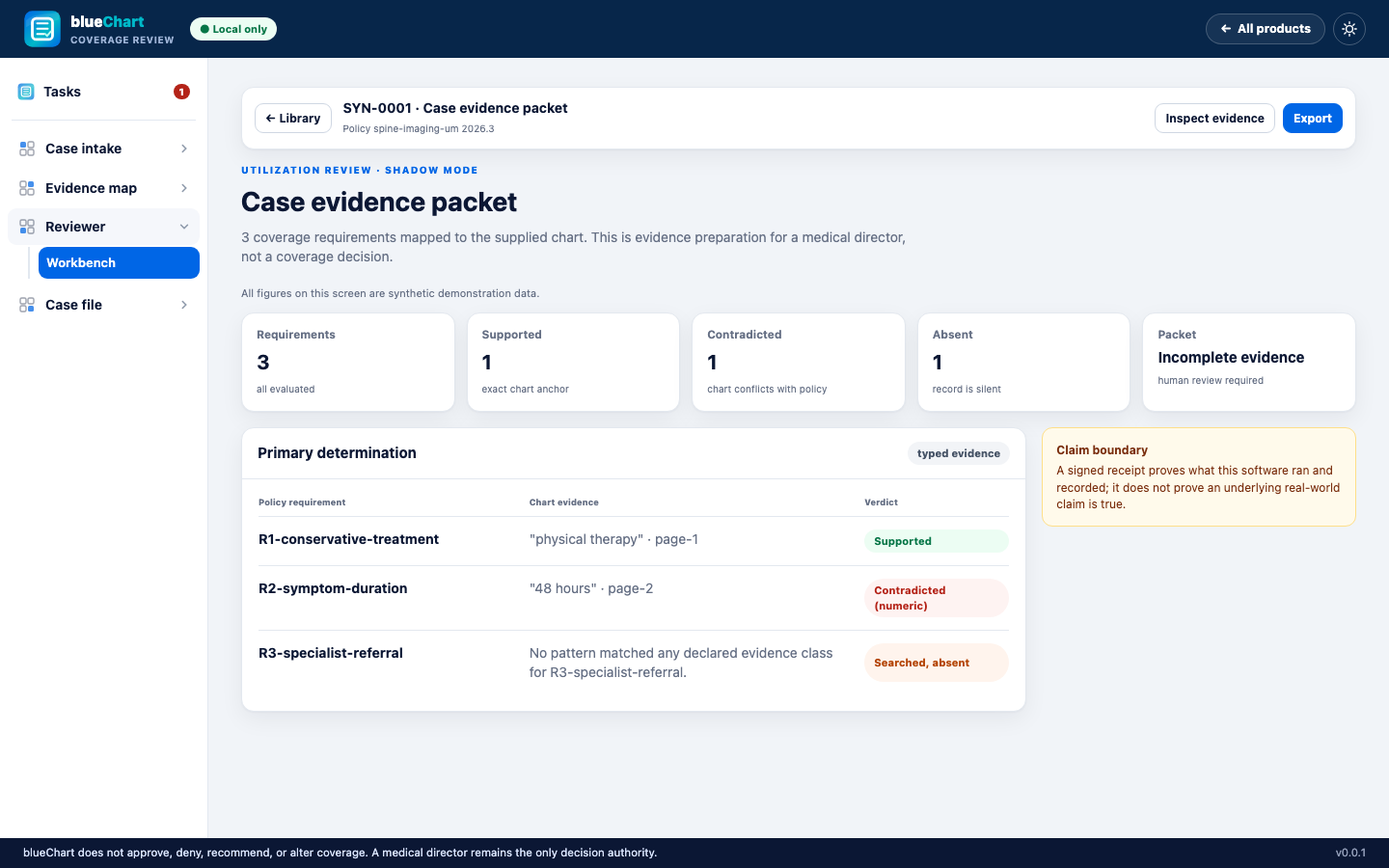
blueChart's typed evidence packet — supported, contradicted, or absent, never one undifferentiated "not found."

The four flagship products are blueChart, blueClaims, blueClinic and blueVigil. Of the eight assurance products in the table, blueChart and blueClaims are in active demo-ready build, with six modules one tier earlier — covering laboratory work, experiment design, review-process measurement and clinical trials. All eight share one signed-receipt foundation and one offline verifier design.
| Product | Job | Tier |
|---|---|---|
| blueChart | Utilization-management evidence mapper | Flagship |
| blueClaims | Claims shadow-review, health + P&C lanes | Flagship |
| blueBench | Experiment preflight gate | Module |
| blueDelta | Manifest diff and candidate minimization | Module |
| blueRecall | Reverse impact when an input goes bad | Module |
| blueNull | Could the experiment have seen the effect? | Module |
| blueCatch | What does a review process actually catch? | Module |
| blueSource | Cryptographic eSource for clinical trials | Module |
measured Built and demo-ready: blueChart and blueClaims, both with full test suites, a working UI, and a standalone offline verifier.
being built In active build: the six research, laboratory and trial modules — real engines and demos exist for each; see each product's own page for what's measured today.
not true yet Not yet true, stated plainly: no pilot is signed, no live PHI has been processed, and there is no non-US or community-edition deployment.