What Blue does, what Blue never does, and who decides

Blue is the optional AI assistance inside blueHealthcare. It is off everywhere until a clinic turns it on, one feature at a time. This page is the whole of it — what we are building, what we refuse outright, and what we withdrew after clinical review. See the technical details and architecture.
No configuration of this software lets a model make a clinical decision. Not in any country, not with any toggle, not with review afterwards.
That is our own rule, and it does not change when a jurisdiction's rules change. The reason is not regulation: a signed value has to stay checkable years later by someone who was never in the room, from the source record and the code. Human review does not make a model's output reproducible.
Rules for AI in medicine are unsettled and differ sharply between countries, and we do not claim to know where they will land. Everything here is off by default, has to be switched on deliberately by named people at a single clinic, and can be switched off again. We are not telling any health system what it should permit.
If there is one doctor in a three-hundred-square-mile area and nobody to help them, we want to have asked how software could responsibly help. In a hospital with a full medical staff and a compliance department, the honest answer may be that all of it stays off — and the software loses nothing when it does.
What Blue is
A name for the assistance, so a clinician who learns it in one tool recognises it in the next. Your clinic can rename it.
Blue offers candidates. A named person accepts, edits or rejects each one, and that acceptance is the recorded act.
What Blue is not
Not a colleague, not a chat window, not a voice. Blue has no opinions and never speaks in the first person.
Blue is never the author of anything signed. Its name appears in the record of what happened, never on a byline.
Blue also helps a clinic get started — as a signed download, before any patient exists in the system.
A clinic installing blueHealthcare on its own machine, with no IT department and nobody experienced to ask, can run the same assistant to get set up. The install itself needs no model at all; the AI layer is one optional add-on that only answers setup questions, only from the manuals bundled with the download. Being built
Works with AI fully off
The install steps, the plain-language health checks, and the signed confirmation record all run with no model anywhere in the path. The AI layer is optional; the setup is not built around it.
The optional AI layer
Off until two people at the clinic turn it on. It answers only from the manuals bundled with the download, shows its source for every answer, and never reads patient data — none exists yet at setup.
Blue can propose. Only a named person can decide.
Nothing is pre-selected and nothing is filled in for you. Each candidate names where it came from. Rejecting is exactly as easy as accepting.
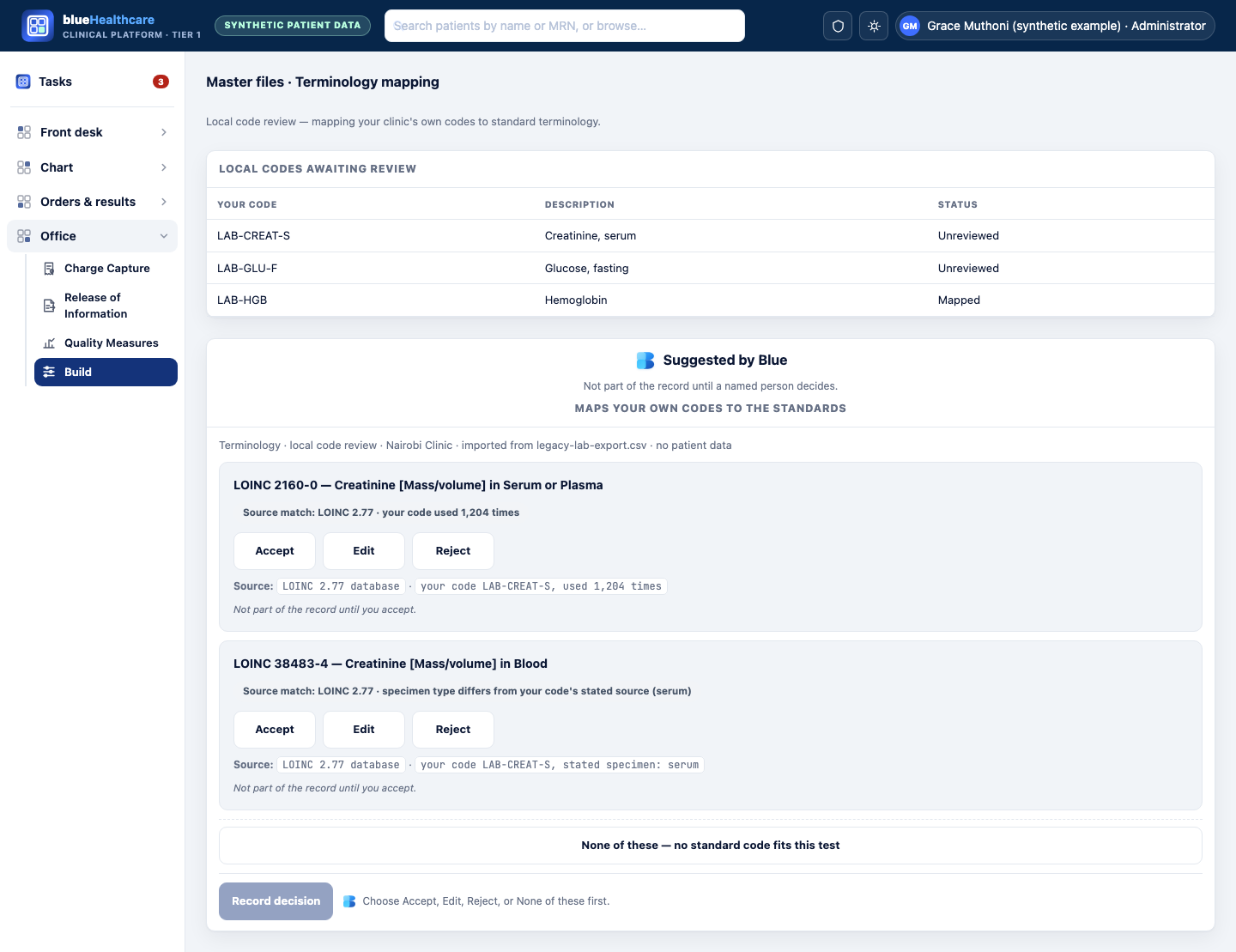
Design mockup. This feature is not built. Shown inside blueHealthcare's real shell (top bar, left rail, product tokens) with synthetic data, composed from the platform's own components — not a live feature, and not a real screenshot of a shipped screen. Accepting and rejecting carry the same weight on purpose. An interface where accepting is one click and rejecting is three has built a rubber stamp, whatever else it says.
Nineteen features. Eighteen read no patient data at all.
Those eighteen need no clinician approver and no jurisdiction question — an administrator can switch them on alone. Every group below links to a detailed page with a synthetic walkthrough and a candidate-card mockup for each tool — what it helps with, who used it and how, what it never does, and its honest build status. Two are already being built; everything else is planned.
of every AI idea we could find is better without AI. We examined 36 parts of this software and wrote down 818 ideas, including the ones we refuse.
Early-warning scores are arithmetic on the values you charted. Duplicate-record detection is ordinary matching. Order sets are your clinicians' own templates. A warning before a shelf goes empty is counting. A lapsed licence is a date comparison. In every one of those, deterministic is not the cautious choice — it is the better one: reproducible, auditable, fast, and it arrives with no toggle, no approval and no answer to a jurisdiction question.
Permanent, regardless of configuration, country, or how good a model becomes.
Added 2026-09-13 by Manead Khin, our clinical authority: discharge/disposition recommendations, triage/acuity assignment, allergy/interaction suggestions, header-source-of-truth fields (code status, isolation), and the absolute prohibition on model-assembled medication lists. Nothing already on this list has been loosened.
Your clinic chooses one, per feature.
On your own hardware
A model inside your own network. Patient data never leaves the building. No internet call, ever.
Your contracted provider
Your own agreement and your own key. Data leaves only if you signed for that, and the provider's identity is pinned — a substitution stops the feature.
Off
The feature is not available, and your clinic loses nothing.
Beside the record system you have, or as the record system you do not.
A patient reading their own record can see where a model contributed — never the model's text, which reaches no patient, but the fact and the nature of it.
Part of this record was prepared with help from an AI tool that suggested information from your chart; your care team reviewed and confirmed it.
Suggested and confirmed — not drafted. The wording is our clinical adviser's, because the accurate frame matters more here than ours did.
We would rather show you this than quietly change a table.
Withdrawn after clinical review
Note-to-list reconciliation. Withdrawn because our clinical authority, Manead Khin, ruled that a model may never assemble or summarize a medication list — full stop, even from already-structured data — and because this feature's own documented scope named allergy and discharge reconciliation, which she added to the never-list the same day.
Message summary for clinician. Withdrawn because drafting a summary of a patient's message is in tension with her never-list entry for triage and acuity assignment — deciding what in a message is urgent enough to summarize is itself a triage judgment.
Superseded, not rejected
A tool that would draft a whole note from a model. Rejected on clinical advice. The structured questionnaire we built instead uses no model at all, works in every country today, and delivers most of the same benefit.
The structured questionnaire we built instead uses no model at all, works in every country today, and already delivers most of the same benefit. Paper capture, clinician translation and dictation each need a named exception from our clinical adviser. None is ours to grant.
Every AI idea we're considering, building, or have ruled out
This page shows what a clinic actually sees. A second page lists the full working catalogue behind it — the ideas being built, the ones still under discussion, the ones on hold, and the ones we turned down, each with a plain reason.
See every AI idea →