Turning a question into a record search
This is the only tool on the current build list that reads a specific patient’s record — which is why it needs a named clinical reviewer’s activation, not just an administrator’s.
Sorting the incoming document tray by patient
This was proposed and then withdrawn on 2026-09-13: deciding which patient a faxed or scanned document belongs to is patient-identity matching, which is on the never-list at any toggle setting. It is named here only for transparency about what we considered and rejected, not as an available or planned tool — no detail, mockup, or status chip is given for it, and it will not appear on the build list again. Sorting a document by kind (“this is a lab report”) for a person who then attaches it themselves is a different, still-open idea, and is not detailed on this page.
Problem candidates from a note
Also permitted and deliberately held rather than built now. The problems half — quoting a note’s own words as a candidate problem-list entry — may survive re-scoping. The medication half does not survive in any form: our clinical authority ruled a model may never assemble, compile, de-duplicate, or reformat a medication list, full stop, even from data a clinic already has in structured form. No mockup or status chip is given because this is not currently being built.
Turns a plain-language question into a record search
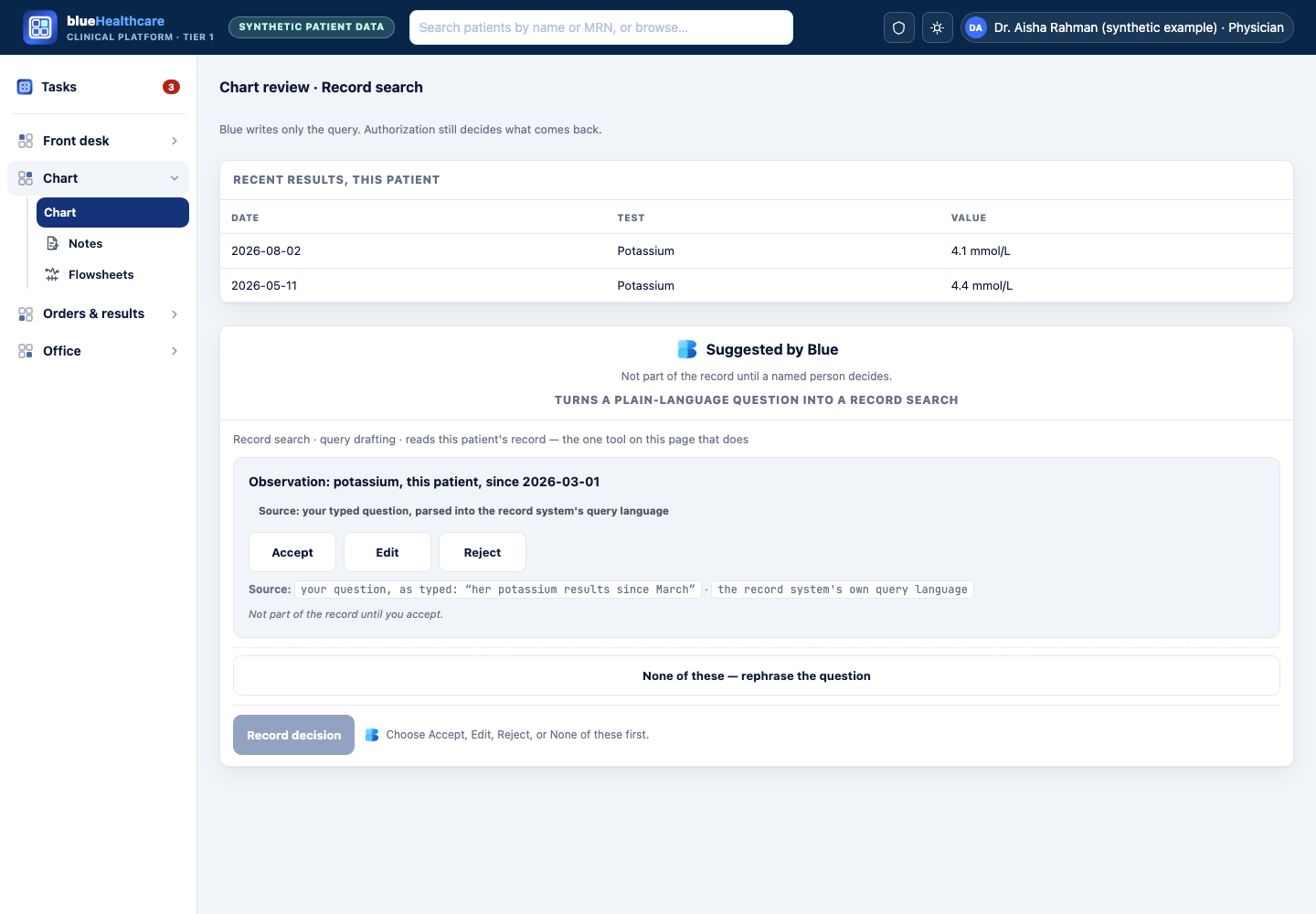
Turns a clinician’s plain-language question into a structured record query. Blue writes only the query — the clinic’s existing authorization rules, unchanged, decide what comes back.
- Who
- Dr. Aisha Rahman (synthetic example), reviewing a patient before a follow-up visit.
- Situation
- She wants to see a specific lab trend quickly, without navigating multiple screens.
- Blue shows
- A candidate query, shown in plain language for her to confirm before it runs: “Observation: potassium, this patient, date ≥ 2026-03-01.”
- They do
- Dr. Rahman confirms the query matches what she meant (or edits it); the record system’s own existing authorization check — not Blue — then decides exactly what she is allowed to see, precisely as if she had built the query by hand.
- Never returns a result itself — it only writes the query.
- Never bypasses or widens what the clinician is authorized to see.
- Never runs before the clinician confirms the query.