
blueCatch
Blinds seeded error cases into a real review queue, imports the reviewer's actual decisions, and signs a scorecard of per-class catch rates with confidence intervals — scoring the process, never a named reviewer.
Quality and review-assurance leads.
Not a live covert-seeding tool, not an employee-surveillance product, and it never touches medical, legal, or financial production records.
blueCatch measures a review process, not the people in it. Known error cases are declared and seeded, blinded, into an exported review queue; the reviewers' real decisions come back in; and the scorecard reports, per error class, what was caught — never blended into one number. The five screens below run that sequence in order: project, audit setup, blind export, scorecard, and the offline verifier.
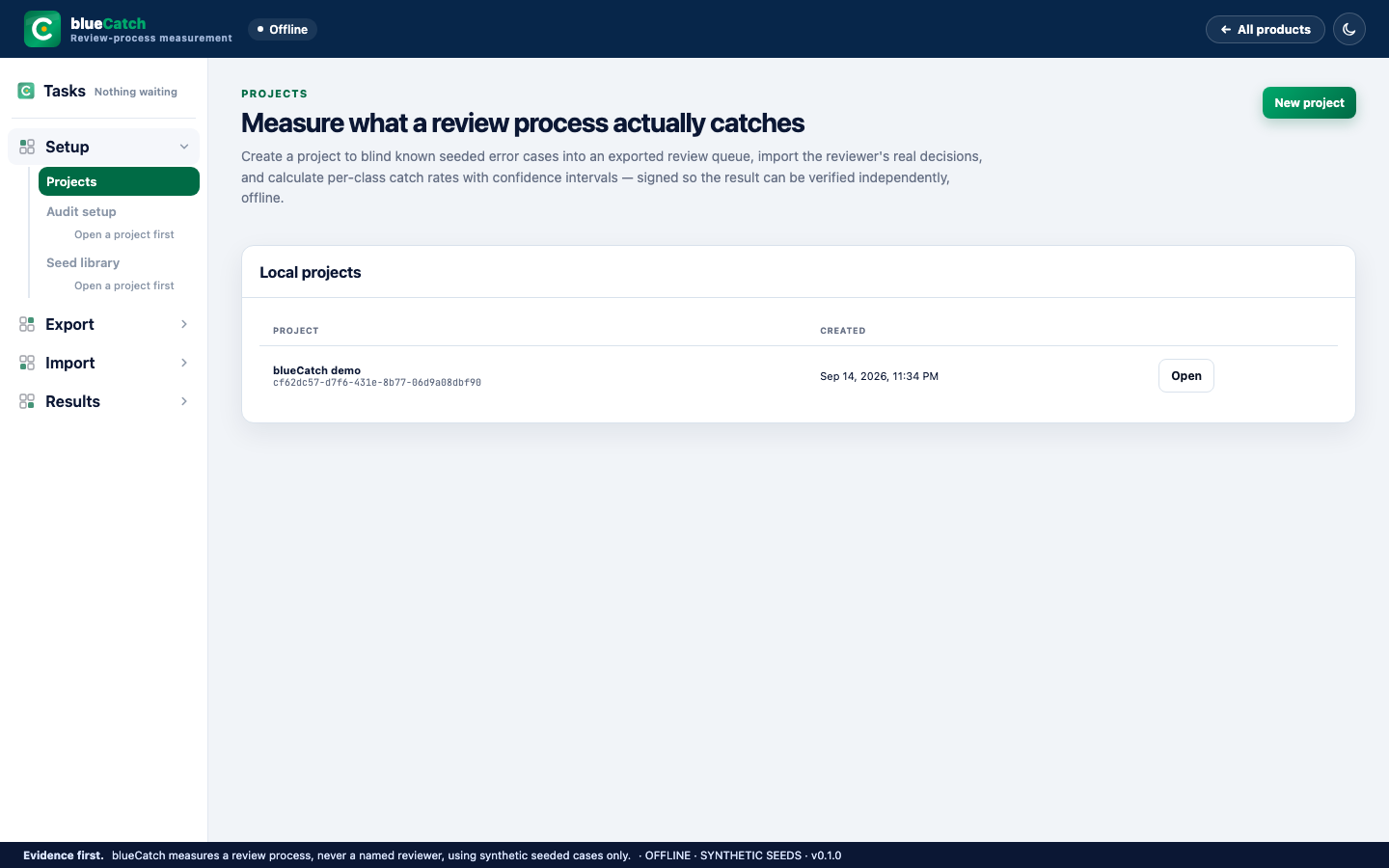
Everything begins with a project. Audit setup and the Seed library stay disabled until one is open. The footer records the posture on every screen: offline, synthetic seeds, and a process measured rather than a person.
Audit setup is where the review queue and the seed library are declared and hashed, before anything runs.

Audit setup — a 100-item review queue and a 10-item seed library, each validated locally and content-hashed before the audit can be sealed. Once every input is declared, the audit freezes and a DECLARE receipt is issued automatically, before any decision data can be accepted.
Blind queue export blends the seeds into the real queue and seals the mix.

Blind queue export — 100 organic items and 10 seeded items blended into one 110-row queue, hashed and sealed, with a Download blind queue CSV button. No column in the preview marks which rows are seeded; that mapping stays sealed until the scorecard, after decisions are imported.
Decision import brings the reviewers' real answers back in; Results scores them.
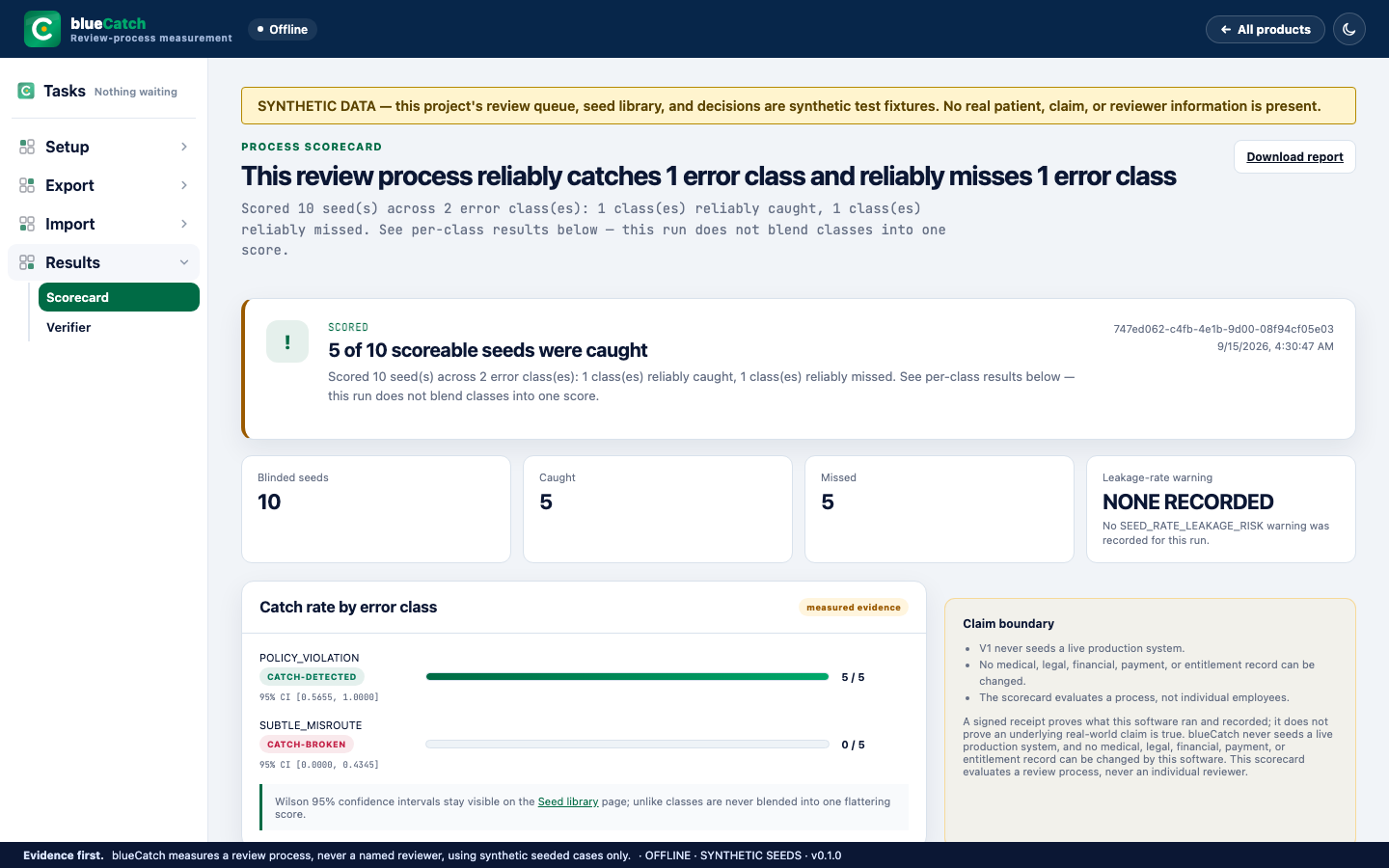
The headline is a sentence, not a percentage. POLICY_VIOLATION 5 of 5, CATCH-DETECTED; SUBTLE_MISROUTE 0 of 5, CATCH-BROKEN — each with its own interval, never blended. A class whose interval straddled the bar would read CATCH-UNDERPOWERED instead of either. Leakage-rate warning none recorded: seeded items were a small enough share of the queue that a reviewer could not have inferred which were planted.
Download report writes the signed scorecard; Verifier checks it without trusting this UI.

Verifier — a SCORED receipt with its signature, schema, and pre-registration chain all valid, checked without trusting this web UI. The same JSON can be pasted into the panel on the right, or checked from the command line with no database and no server running.
CLI, API, and web UI exist with a 100-item synthetic demo queue. see the status page for exactly what's built.