
blueClaims
Anchors every finding to the exact policy clause behind it, and to the specific record document and its hash. Types every “not found” so a denial can never claim absence of evidence the review couldn’t have looked for.
Claims adjusters and compliance leads at a payer or carrier.
blueClaims never approves, denies, pays, reserves, or alters a claim. The human adjuster is the only adjudication authority.
Clinical text stays where it is. A record anchor names the document and its hash, not a quoted passage. Capturing an excerpt into a packet is a separate step your clinic turns on and approves — off by default, so no clinical text leaves a record unless someone decided it should.
blueClaims works a claim in shadow: the policy, the record bundle and the claim's service lines are loaded together, every finding is tied to the plan clause and the record document (by hash) that earned it, and every "not found" is typed so nobody can later claim absence of evidence the review could not have looked for. The screens below follow the bundled synthetic health claim from an empty library to the signed receipt.
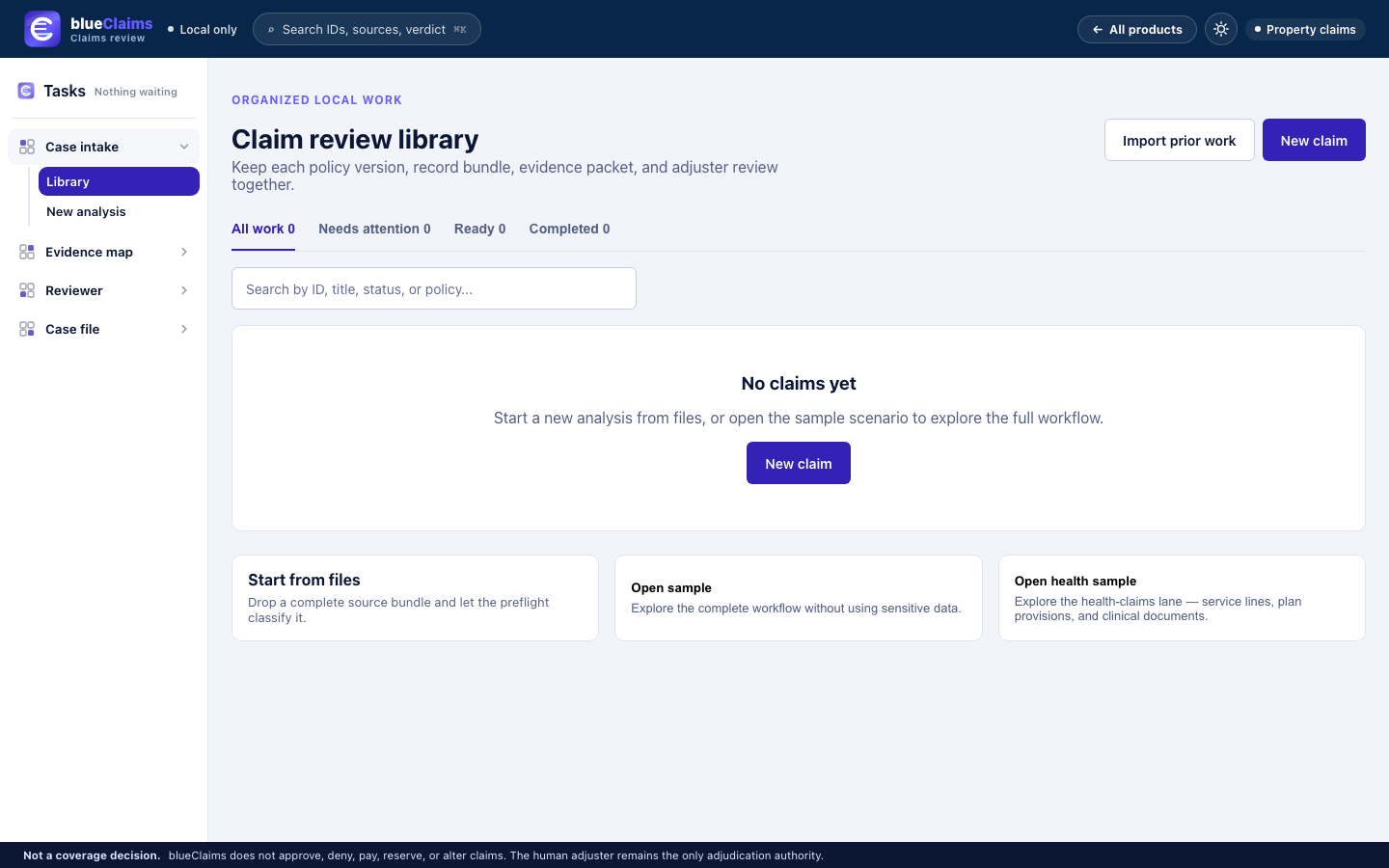
First run — nothing is loaded until you load it. Three ways in: drop a complete source bundle and let the preflight classify it, open the property-loss sample, or open the health-claims sample.
Opening both samples gives the library below.

Claim review library — one health claim and one property-and-casualty claim, each with its policy version, record bundle, evidence packet and adjuster review kept together. Both states shown here mean the same thing: an adjuster has to look.
Open lands on the packet.
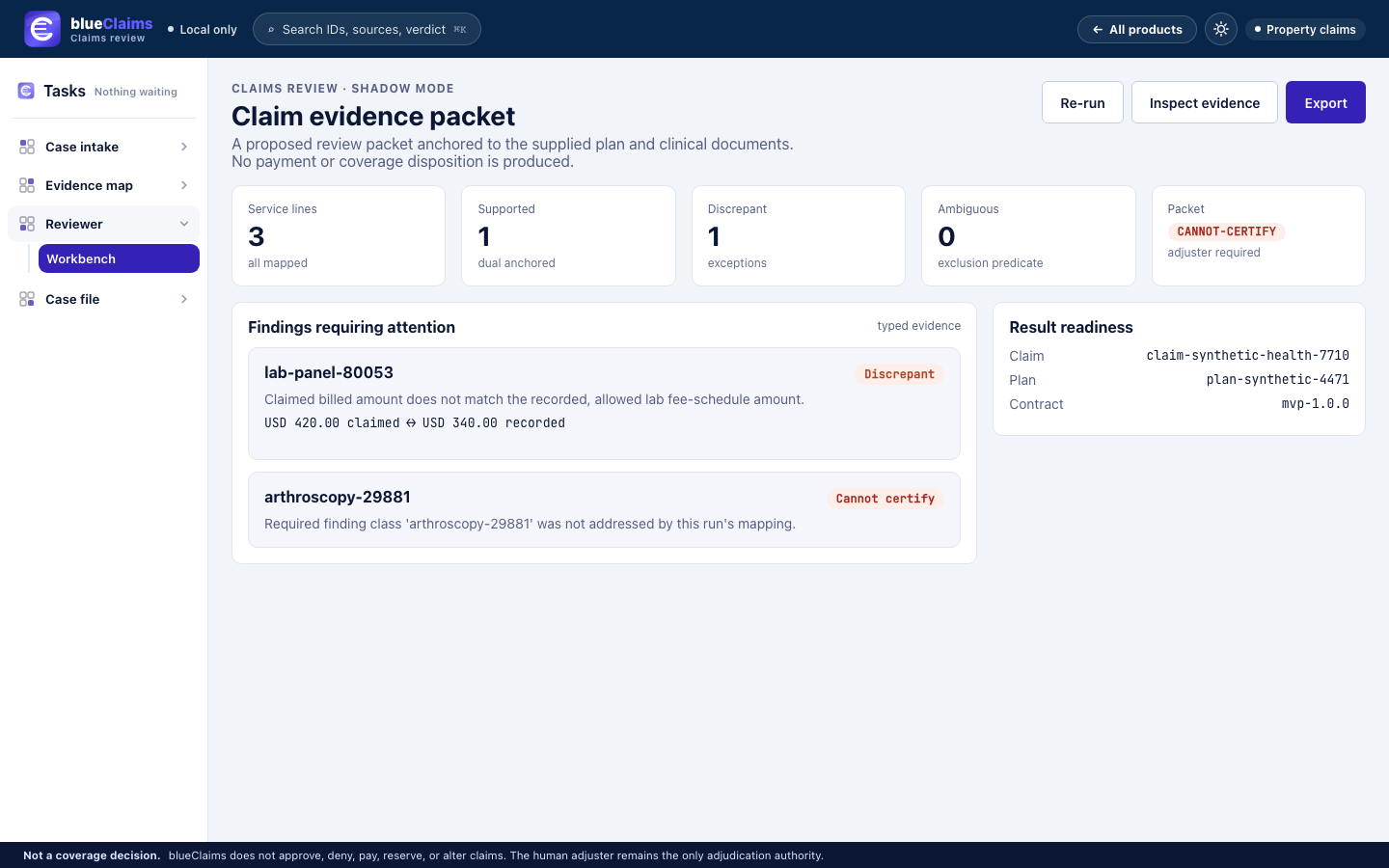
Claim evidence packet — the two findings an adjuster must look at, in words: a billed amount that does not match the recorded fee schedule, and a service line the mapping never addressed. The packet is CANNOT-CERTIFY because of the second, not because anyone judged the claim. Re-run, Inspect evidence and Export are the only actions.
Inspect evidence shows what each finding is tied to.
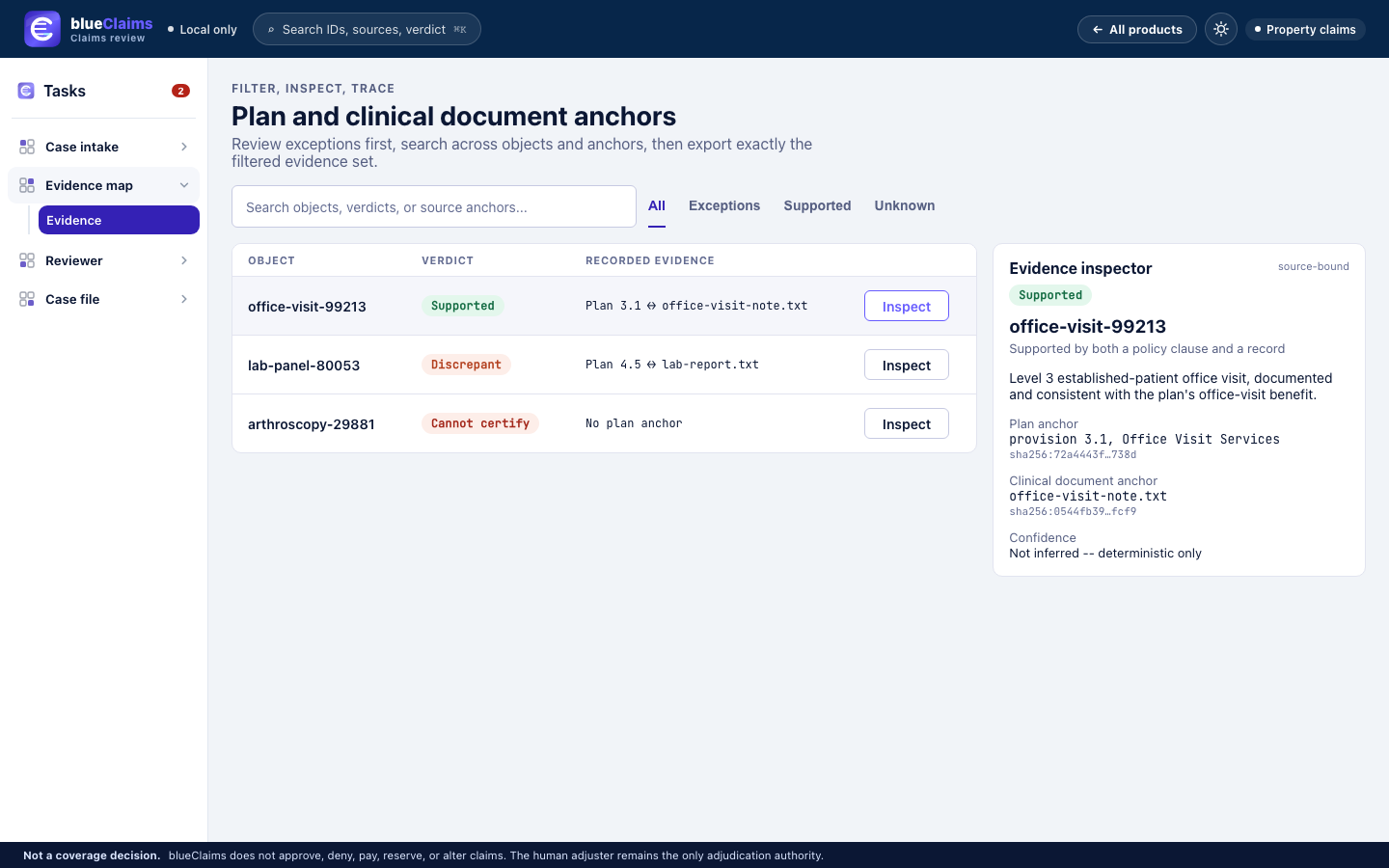
Plan and clinical document anchors — office-visit-99213 is Supported by plan provision 3.1 and the office-visit note, each named with its SHA-256; lab-panel-80053 is Discrepant against provision 4.5 and the lab report; arthroscopy-29881 has no plan anchor at all. The inspector's confidence line reads Not inferred — deterministic only.
Only the document name and hash are recorded here; the clinical text itself stays in the record unless the clinic has turned excerpt capture on. Export writes the signed receipt below.

Signed process receipt — this run is the property-loss claim, state NEEDS-HUMAN-REVIEW, with its input hashes and payload hash listed above the finding-by-finding body. Run offline verification performs the identical check without an account, a product database, or a MOBLUEHQ server.
Engine, receipts, persistence, CLI, API, and a working web UI are real and tested for both lanes (health and property & casualty). All five export formats, run ancestry, interrupted-run recovery, drafts/autosave, seeded-scale performance testing, an accessibility audit, and clean-machine packaging are done.
Not yet true: Library pagination at large record counts is a known, named gap. No signed pilot. No live PHI.