
blueSource
Secures clinical trial data collection with cryptographic signing and tamper detection, producing verifiable electronic source records.
Clinical trial sponsors, CROs, and research integrity teams.
blueSource does not judge whether a value is clinically right. BOUND means the value on the form matches a signed source version — nothing more. It does not read free text: anything without a coded, signed source is left blank for a person to enter. And the key it trusts today is this install's own, not a company-wide root — a monitor verifying a bundle is verifying that this install signed it. It is not a trial management system, not an electronic data capture platform on its own, and not a replacement for existing trial infrastructure.
blueSource binds each value on a case report form to a signed version of the source record it came from, so a study monitor can verify the binding without ever reading the chart. The four screens below follow one synthetic study from the roster, into a populated form, to the discrepancy queue that catches anything short of a clean bind, and on to the monitor's view — where every value is withheld and verification still succeeds.

Study roster — three enrolled subjects, each with a visit, its window, and binding health per form: 8 of 9 items source-bindable, then how the bindings stand — BOUND, UNBINDABLE, SUPERSEDED or CANNOT-CERTIFY. The ninth item on every form is an investigator narrative that has no coded, signed source and is always entered by hand.
Open a subject's visit to see the form itself.

Form population — values populate deterministically from coded, signed source records; nothing is generated by a model. Five lab values are BOUND, one is CANNOT-CERTIFY because its source signer isn't in the trusted root, and Baseline ECG QTc is UNBINDABLE because no signed source exists for it — every gap is typed, never left blank without saying why.
Anything that is not a clean BOUND goes to the discrepancy queue, never a silent pass.

Discrepancy queue — every failed binding and every source that changed after it was already bound, across the whole site. The SUPERSEDED row is the sharpest case: a subject's active medication was bound to Lisinopril 10 mg, and the source record has since changed to resolve to 20 mg — flagged, not silently updated.
From here, the monitor sees none of these values — only whether each binding holds.
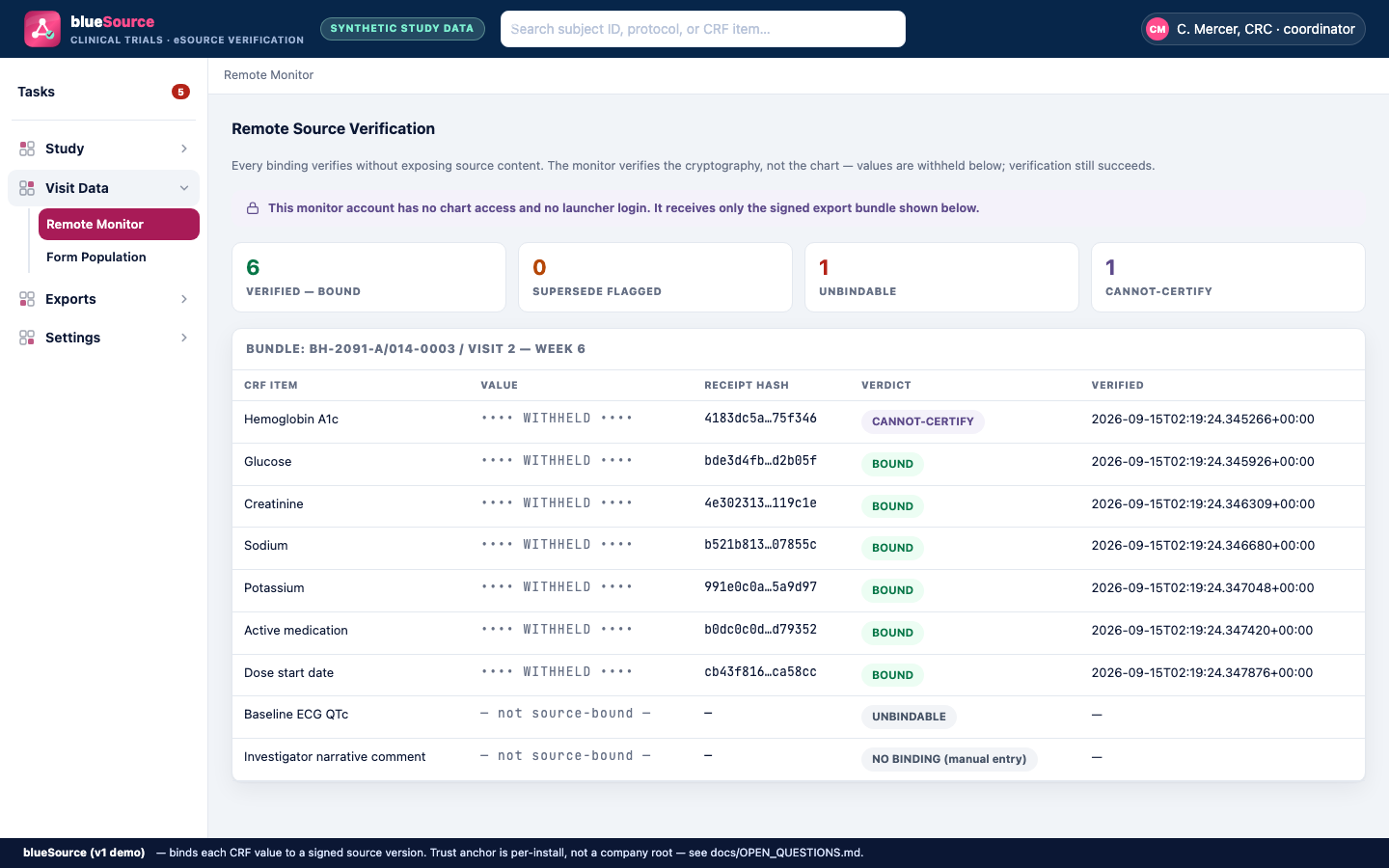
What the monitor sees. Values withheld, hashes and verdicts shown, verification succeeds anyway — the monitor checks the cryptography, not the chart. The two items without a binding say so in words instead of showing an empty pass.
Demo build (v1) complete with core cryptographic signing, receipt generation, and verification tools.
Not yet true: No clinical trial deployment. No real trial data processed.